A new investigation by Jeremy McGowan
THEDISCLOSURE
TRAP
When America asks for answers, who else is listening?
MSSChina
Ministry of State SecurityFSBRussia
Federal Security ServiceGRURussia
Main Directorate of the General Staff of the Armed Forces of the Russian FederationSVRRussia
Foreign Intelligence ServiceMOISIran
Ministry of Intelligence and SecurityRGBNorth Korea
Reconnaissance General Bureau
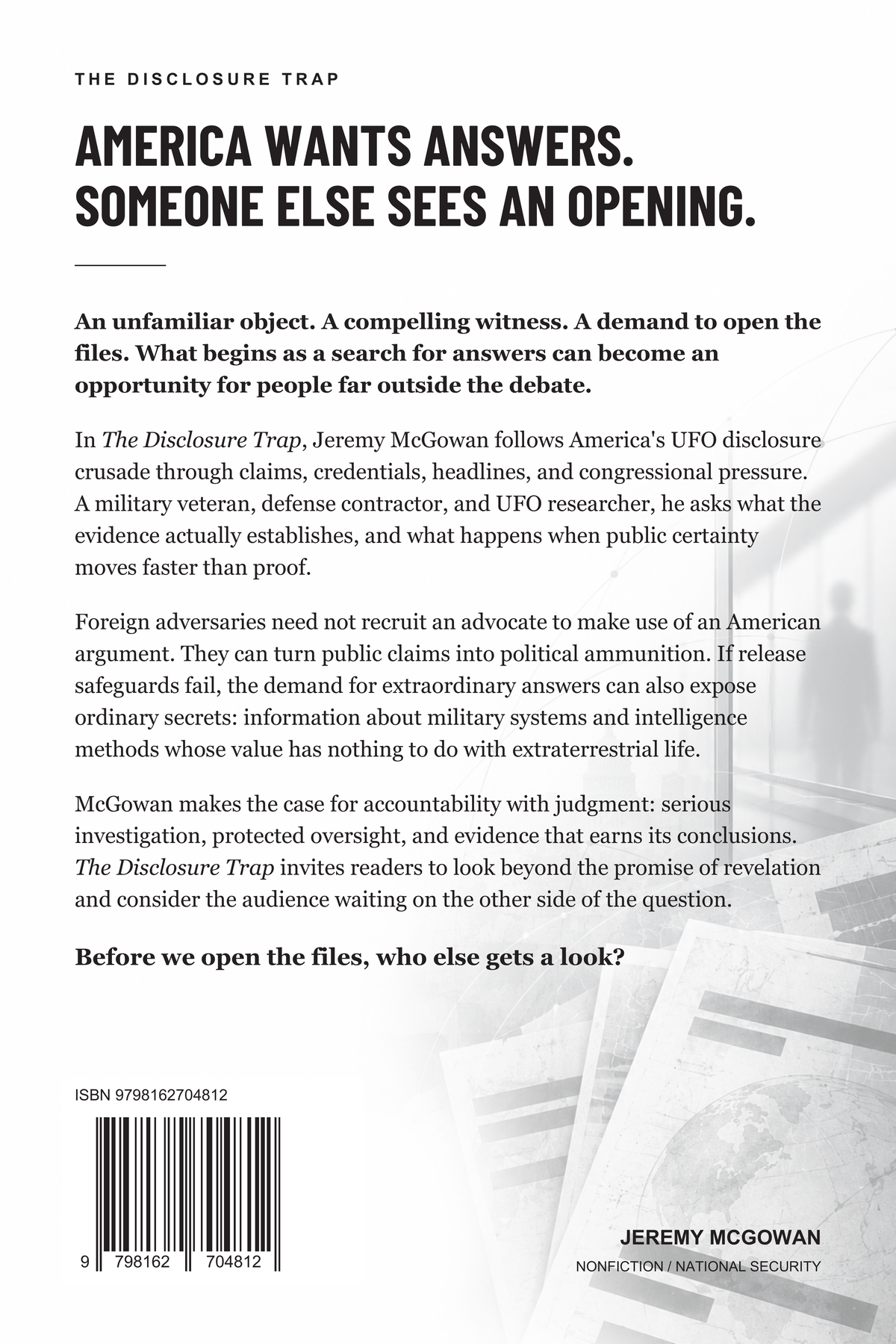
An examination of how the American UFO disclosure crusade is useful to foreign adversaries, and what demands for unrestricted disclosure puts at risk.
Submitted to the Defense Office of Prepublication and Security Review (DOPSR). Publication date to be announced.

Select either cover to open a larger view.
How America's UFO Disclosure Crusade Aids Enemies of the State
American voices. Foreign advantage.
Read the editorial noticeThe question behind the book
EXTRAORDINARY CLAIMS HAVE EXTRAORDINARY CONSEQUENCES
A witness sees something they can't explain in the sky. An extraordinary explanation takes hold. A demand for answers becomes a political cause. Once that story enters public circulation, unintended consequences can change the strength of the national security of the United States.
Political reuse
Claims of reverse engineered alien technology and UFOs are exploited by foreign intelligence agencies.
The book examines foreign political reuse of American disclosure advocacy. Its argument does not require the Americans involved to have been recruited, directed, or knowingly cooperating.
Release risk
An extraordinary interpretation can surround ordinary secrets.
The book separately examines the risk that disclosure demands could expose useful conventional military or intelligence information if safeguards fail. That risk is not proof that a particular compromise occurred.
Truth deserves evidence. Released information requires judgement.
THE ANATOMY OF SENSATIONALISM AND ITS USE BY ENEMIES OF THE STATE
Follow the claim.
How a mistaken observation can have unintended consequences.
The author behind the investigation
On screen. In print. A different question.

Research paper / SSRN preprint / 2025
How Thiel, Musk & Omidyar Turned UFO Hype into a Security Risk
McGowan's analysis of UFO disclosure narratives, influential networks, and the national security risks he argues they can create.
Selected screen appearances
Public appearances across a changing conversation.
 Documentary film / 2022
Jeremy's Land Rover at night. Author archive photograph.
A Tear in the Sky
Appearing as himself
An appearance in a film about a public effort to investigate unidentified aerial phenomena.
View film : A Tear in the SkyFilm information. Viewing options may require payment.
 Documentary series / 2023
Mission Unexplained publicity scene. Blue Ant Media.
Mission Unexplained
Appearing as himself
His account is featured in a series built around unexplained experiences reported by military personnel.
View program : Mission UnexplainedProgram information. Availability varies by region and provider.
 Documentary film
Dark Alliance trailer graphic. Promotional imagery and speculation.
Dark Alliance: The Next Generation
Appearing as himself
A documentary appearance within the wider public discussion of UFO claims and investigation.
View film : Dark Alliance: The Next GenerationFilm information. Viewing availability and cost vary.
The public account
Before the book, a search for answers.
The following essays, published in 2022, recount Jeremy's initial experience and introduction to the world of UFOs. The essays follow his journey through a web of attempted indoctrination, lies, and opportunism by some of today's most prolific UFO celebrities and provide insight on how he became the skeptic of people's claims that he is now.
Original AI-assisted editorial illustrations inspired by the essays; not documentary photographs.

Part 01 /
My search for the truth about UFOs: Part 1 — The First Sighting.
The personal sighting that began his search, and the questions it left open.

Part 02 /
My search for the truth about UFOs: Part 2 — “WTF just happened?”
An account of investigation, instrumentation, and encounters with the public UFO community.

Part 03 /
My search for the truth about UFOs: Part 3 — “Red Flags, Red Flags Everywhere!”
The author's scrutiny of credibility, evidence, and the incentives surrounding public claims.

Part 04 /
My search for the truth about UFOs: Part 4- "The Wyoming Aftermath."
His reflection on the Wyoming experience and the judgments that followed.
Publication status
The investigation continues.
Publication is pending.
About prepublication review
DOPSR—the Defense Office of Prepublication and Security Review—reviews written material before public release to identify classified and other protected government information.
Jeremy’s military service and defense-contracting background carry continuing responsibilities to protect information learned through that work. Because this book addresses military and national-security matters, he submitted the manuscript for prepublication security review before publication.
DOPSR coordinates with the government offices responsible for the information in a manuscript. Reviewers check for protected details and issue a written release decision, which may require changes or deletions before publication.
Submitted to the Defense Office of Prepublication and Security Review (DOPSR). Publication date to be announced.
DOPSR review informationThe manuscript has been submitted to the Defense Office of Prepublication and Security Review (DOPSR). Clearance has not been established.
Publication updates
Stay with the investigation.
Request news when a publication date is established and The Disclosure Trap becomes available.
For Jeremy's public posts in the meantime:
Follow @desertdiaries on XNotification requests are stored for Jeremy McGowan to review.
Open the publication-update request form
For contact, privacy, accessibility or withdrawal requests, use the contact form.
Squarespace stores your email address and your permission to receive book-publication news so your request can be fulfilled. Use the contact form linked below to withdraw your request. The privacy notice explains notification requests and the separate contact service. Privacy details
Contact the author
Contact the author - especially if you are a fan, an agent, or a publisher with a large check. Submit your message in the form - 1000 characters max. Do not send threats, harassment, or personal attacks against the author or fellow readers. Accepted messages are recorded with the connection IP address, a submission ID and the server time. Relevant evidence may be reviewed for a report to appropriate authorities. Any referral is a separate human decision; messages are not automatically forwarded.
Messages are screened automatically before manual review. No automatic email reply is sent.
Do not include passwords, government identification documents, classified information, or unnecessary sensitive information.
The separate Cloudflare contact service stores accepted messages privately with the connection IP address, a submission ID and UTC server time. Messages blocked by the content filter are not saved as contact submissions. IP addresses are scheduled for removal after 30 days by an hourly purge, unless a documented case hold with a recorded end date applies. D1 recovery can retain earlier data for seven days after changes to active records. Relevant evidence may be exported for a potential manual referral; no message is automatically forwarded. Your ZIP or postal code is self-reported and is not matched to an IP location. Contact does not subscribe you to publication news. Privacy notice
Editorial notice
The Disclosure Trap was authored in the State of Nevada, United States. This independently authored work presents analysis, criticism, and commentary concerning public claims about unidentified flying objects and unidentified anomalous phenomena, disclosure advocacy, and potential consequences for U.S. national security. Names and likenesses identify individuals whose public statements, activities, or influence the book examines. Their inclusion serves an editorial purpose and does not represent their authorship, participation in the book’s production, authorization, sponsorship, approval, or endorsement.
The book’s central distinction is between the potential consequences of public advocacy and the intentions of the people engaged in it. Its thesis concerns whether foreign governments or intelligence services could exploit aspects of disclosure discourse to advance interests adverse to U.S. national security, including without the knowledge, intent, cooperation, or consent of the individuals whose statements or activities the book discusses. An assessment that a statement, narrative, or policy could benefit a foreign adversary is not an accusation that the person advancing it serves that adversary, shares its objectives, or intends such a benefit. The possibility of exploitation does not, by itself, establish that exploitation occurred.
The cover is a constructed editorial illustration, not documentary evidence or a representation of an actual gathering or event. Its puppet strings, controlling figure, altered clothing, military-style insignia, and national imagery function as visual metaphors for the author’s concerns about potential exploitation and unintended consequences. These elements do not assert that any depicted individual wore the illustrated clothing, held a foreign military rank, accepted foreign orders, or maintained a recruitment, financing, tasking, direction, or control relationship with a foreign government or intelligence service. The grouping of individuals does not assert a common plan, coordinated conduct, or shared intent.
In the subtitle, “Enemies Of The State” refers to foreign adversaries of the United States, not to the Americans portrayed on the cover or to people who advocate disclosure. The word “aids” concerns the author’s assessment of potential consequences or advantages, not an accusation of intentional assistance. Neither the cover nor the central thesis it illustrates accuses the depicted individuals of espionage, treason, covert foreign allegiance, or knowing participation in a foreign intelligence operation. The cover’s symbolism does not identify any depicted individual as a foreign agent or establish an operational relationship between that individual and a foreign power.
The author offers interpretations, inferences, and assessments of risk for evaluation against the factual material and sources identified in the text. Those judgments do not purport to reveal undisclosed evidence of secret foreign relationships or instructions. Hypothetical scenarios and fictional illustrations, where expressly identified as such, describe possibilities rather than reported events. Similarities between public narratives and foreign interests do not, without additional supporting evidence, establish coordination, operational involvement, or control. Readers should distinguish factual statements, attributed claims, analytical judgments, and hypothetical examples according to their content and context.
The views and assessments expressed are the author’s own. They do not purport to represent an official finding, intelligence assessment, or position of the United States Government, any government agency, or any present or former employer. References to institutions, professional affiliations, military service, or public positions provide context and do not imply institutional approval of the book or its conclusions.
To the extent Nevada law applies, the author invokes the exceptions to the written-consent requirement established by Nevada Revised Statutes (NRS) 597.790(2)(c), (d), and (f). Subsection (2)(c) addresses qualifying uses associated with news and public-affairs publications. Subsection (2)(d) addresses portrayals and simulations of individuals in books and other identified expressive works, except when the use directly connects to commercial sponsorship. Subsection (2)(f) addresses advertisements and commercial announcements for uses permitted by that subsection. The likenesses in this work identify subjects of substantive commentary rather than purported sponsors or endorsers. The author relies on these exceptions subject to their statutory conditions, not as an unrestricted authorization to exploit an individual’s identity. Nevada Legislature
The author also invokes the freedoms of speech and press protected by article 1, section 9, of the Nevada Constitution and by the First Amendment to the United States Constitution, as applied to the States through the Fourteenth Amendment. These authorities provide the constitutional foundation for the author’s exercise of protected expression concerning matters of public interest. See Nev. Const. art. 1, § 9; U.S. Const. amend. I; amend. XIV, § 1. Nevada Legislature
Federal judicial decisions recognize that the First Amendment can protect expressive portrayals of real individuals against state-law publicity claims. In Sarver v. Chartier, 813 F.3d 891, 905–906 (9th Cir. 2016), the court held that applying California’s right-of-publicity law to the expressive film at issue would violate the First Amendment. The author invokes that constitutional protection to the extent applicable to this book’s editorial treatment of its subjects.
The author further invokes constitutional protection for criticism, opinion without a provably false factual implication, and rhetorical hyperbole that reasonable readers would not understand as an assertion of actual facts. These protections depend on the substance and context of the expression, not merely its designation as opinion, commentary, or illustration. See Milkovich v. Lorain Journal Co., 497 U.S. 1, 18–21 (1990).
The author claims no ownership in any person’s identity or in independently owned third-party material.
“Enemies of the State” in the subtitle refers to foreign adversaries of the United States. The book examines potential consequences and advantages, including reuse without the knowledge, intent, cooperation, or consent of the Americans discussed. It does not accuse depicted individuals of espionage, treason, or knowing service to a foreign power.
The book's analytical judgments are distinct from reported facts and attributed claims. The Light Over the Range is explicitly fiction and is not factual evidence. Security-review permission, if granted, would not establish Government endorsement or factual validation.
The views are the author's. No Government agency, broadcaster, platform, or person referenced here is represented as sponsoring or endorsing the book.
Privacy details
Squarespace stores your email address and your permission to receive book-publication news so your request can be fulfilled. Use the contact form linked below to withdraw your request. The privacy notice explains notification requests and the separate contact service.
Read the full privacy notice · California & EU privacy rights · Cookies & tracking